Honey bees
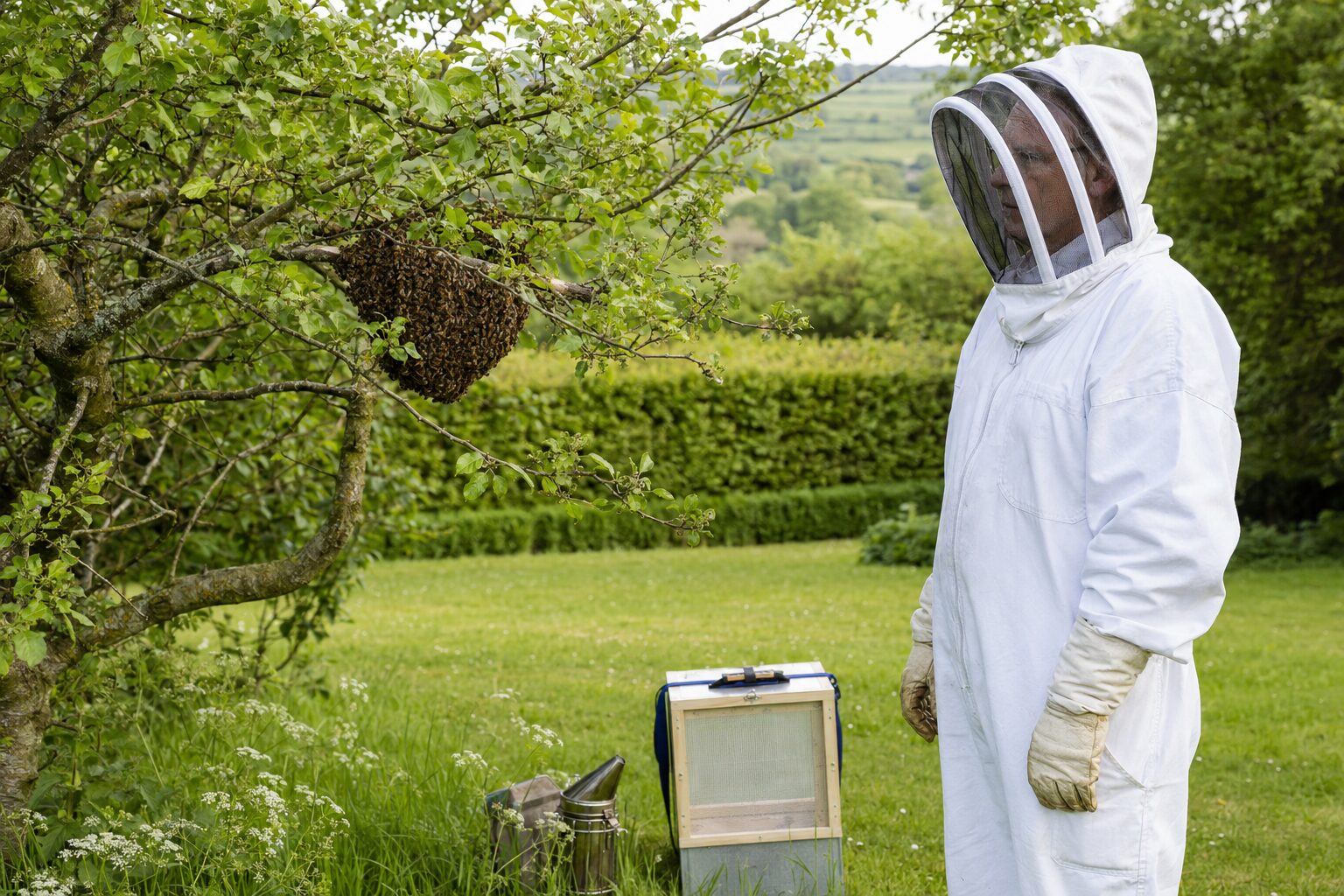
Usually golden-brown with darker bands and a fairly slim, softly hairy body. A swarm contains thousands gathered into a dense ball or teardrop, often on a branch, hedge, fence or wall.
Local identification and collection guide
A large cluster of bees can be alarming, but the right response depends on the insects and where they are living. This locally reviewed guide will help you decide whether you have a collectable honey-bee swarm.
Report a possible swarm
First check
Do not approach closely just to identify them. A safely taken photograph can help Mike or another volunteer confirm what you have.
Usually golden-brown with darker bands and a fairly slim, softly hairy body. A swarm contains thousands gathered into a dense ball or teardrop, often on a branch, hedge, fence or wall.
Larger, rounder and noticeably furry, often with bold bands or a coloured tail. They commonly nest in the ground, compost heaps, bird boxes or sheltered cavities and are not collected as honey-bee swarms.
Smooth-bodied with a narrow waist and bright yellow-and-black markings. Repeated traffic into a papery nest or cavity may require a professional pest controller rather than a beekeeper.
Do not spray or disturb the insects. Send a clear photograph by WhatsApp whenever it is safe to take one.
Location matters
A visible cluster that has recently arrived is different from bees that have occupied part of a building.
A dense exposed cluster appears suddenly and remains together while scout bees search for a permanent home. It may stay for a few hours or several days and can leave without warning.
Bees repeatedly enter and leave the same hole in a wall, roof, chimney or soffit over many days. Removal may require specialist surveying and building work.
Provide the exact location or what3words address, approximate height, when the bees appeared, access information and photographs of both the insects and the wider location.
After your message
Mike reviews your description and photograph to determine whether the insects are likely to be honey bees.
The height, location, traffic, livestock, ladders and other access considerations are checked before a volunteer attends.
If the swarm is accessible and a beekeeper is available, MDBKA coordinates collection. Timing depends on availability and the bees remaining in place.
The bees are carefully collected and moved into suitable accommodation where the colony can be monitored and cared for.
Local volunteer service
MDBKA responds within approximately 15 miles of Malton, subject to beekeeper availability, confirmation that the insects are honey bees and safe access.
Malton, Norton-on-Derwent and nearby communities along the Derwent.
Salton, Brawby, Hovingham, Slingsby, Amotherby and surrounding villages within the collection area.
Rillington, Sherburn, Settrington, West Heslerton and nearby villages.
Pickering, Kirkbymoorside and locations close to the 15-mile boundary may be covered depending on the exact address and volunteer availability.
Reviewed 25 July 2026 by Mike England, MDBKA swarm coordinator. If unsure whether your location is covered, send the postcode or what3words address by WhatsApp.
Keep people and pets back, do not disturb the bees, and send the location and a photograph. WhatsApp is usually most reliable.